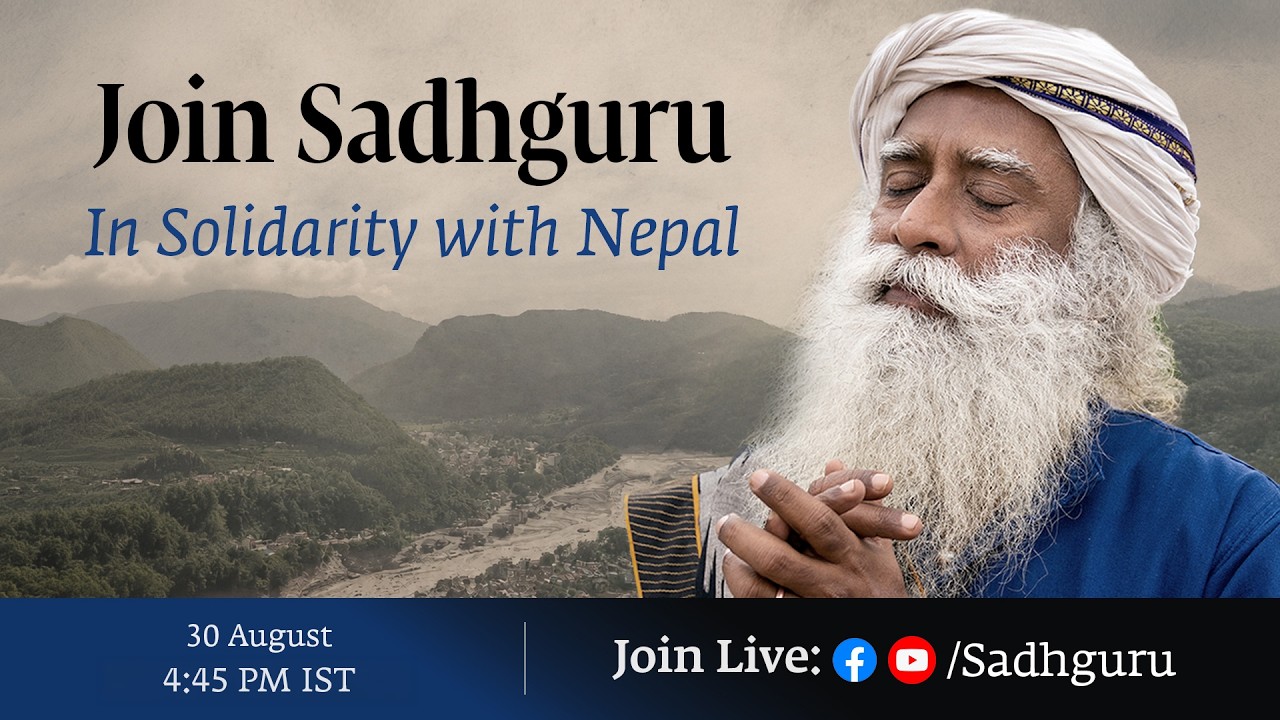
The room is quiet, then Sadhguru speaks—or rather, he asks a question that breaks the silence. His students have just asked how he is, all at once, a synchronized chorus of care. He pauses. "Why are all of you asking in one voice? Something wrong with me?" There's laughter, a moment of lightness. Then he stops pretending. "Well, a little wrong with me."
This is not a teaching delivered from a stage. This is a check-in, a moment of reckoning between a spiritual guide and his community after something terrible has shifted in the fabric of their shared practice. What happened in Nepal was not abstract. It was catastrophic—a flood or avalanche that wiped out eighty of his students, all of whom were wearing sutras, energetic tethers he had tied to them before they departed for the Kailash Yatra, one of the most spiritually charged and physically demanding pilgrimages in the Hindu tradition.
The Sutra System and the Price of Protection
To understand the weight of what Sadhguru is describing, the sutra practice must be held in proper context. Before students undertake the Kailash Yatra—a high-altitude pilgrimage to Mount Kailash in the Himalayas where altitude sickness and environmental hazards claim thirty to forty lives annually—Sadhguru ties sutras, or sacred threads, to each participant. These are not symbolic ornaments. In his framework, they are energetic anchors, a direct connection between his own energy system and theirs, designed to insulate them from the lethal risks that come with climbing above sixteen thousand feet.
Over many years, this practice had worked. Not a single death among his students. A perfect safety record in an environment where mortality is routine. The sutra system was, in other words, a functioning technology of protection—one that required him to hold a certain energetic coherence, to maintain himself as a stable anchor point for dozens of people walking toward physical extremity.
Then the unthinkable: a catastrophic event that struck eighty students simultaneously, all tethered to him.
The Teacher's Hidden Burden
What Sadhguru reveals in this raw moment is something rarely articulated in spiritual teaching: the teacher carries the weight not just of their own practice, but of their students' safety and karma. When eighty people are energetically connected to you, and catastrophe breaks that connection, the rupture is not external—it is borne internally. "Breaking my energy system badly," he says. "That uh I'm a little not so stable. Trying to get myself into order."
This is not melodrama. He is describing a genuine destabilization of his energetic infrastructure—a consequence of having extended his being to stabilize eighty others, and then having that extension violently severed. The damage is not psychological, though it manifests as a kind of shakiness; it is energetic, structural. He has "caused some damage" to himself by absorbing the blow that was meant to bypass his students.
There is a teaching embedded in this vulnerability. Most spiritual literature presents the master as invulnerable, untouched by circumstance. Sadhguru does the opposite. He appears unstable. He admits it. He asks his students to stand with him—not metaphorically, but as a living, present force to help him recalibrate. "All of you stand with me, huh?" The response is immediate and unequivocal: "Yes, we are. Yes, we are. Yes, we are."
The Question of Dharmic Responsibility
This moment crystallizes a central tension in spiritual teaching: how much of a teacher's being can be extended toward others without compromising their own integrity? Sadhguru had created a system—one that worked for years—by taking on the risk himself. He paid the energetic price so his students would not pay it in blood. The sutra system was a bargain struck between his own stability and their safety.
The Nepal disaster reveals both the power and the vulnerability of that bargain. The system protected people in normal circumstances. But when catastrophe is large enough to overwhelm the entire group simultaneously, the teacher cannot absorb it. The teacher breaks. And then the question becomes: what does a broken teacher do?
Sadhguru's answer is to acknowledge the break, to ask for support, to declare intention ("Let's make it happen because there are many things to do") even while admitting damage. He does not retreat into silence or disappear to heal in isolation. He sits with his students and says, essentially: I am hurt, and I need you. This is either the opposite of spiritual mastery or its truest expression, depending on how you understand what mastery means.
The Path Forward
What makes this moment significant is not that a teacher suffered loss—every teacher does. It is that he chose to be transparent about it. Most spiritual traditions would script this differently: the master would withdraw, do invisible work, and return healed, intact. The students would be reassured that nothing was wrong. The narrative would be preserved.
Instead, Sadhguru says, "I'm a little not so stable. Trying to get myself into order." He normalizes the work of repair. He acknowledges that some damage cannot be absorbed instantly, that even a seasoned guide must recalibrate. And he does this not behind closed doors but in front of his community, asking them to witness and support the work.
There is an old teaching in Advaita that the guru and the disciple are not separate, that the lineage is a unified energetic field. This moment—stark and brief as it is—demonstrates what that actually means when something goes catastrophically wrong. It means the teacher cannot hide. It means the students' care is not ornamental but necessary. It means the path forward requires all of them, broken and whole together.